Gardeners Soho — Insurance and Safety
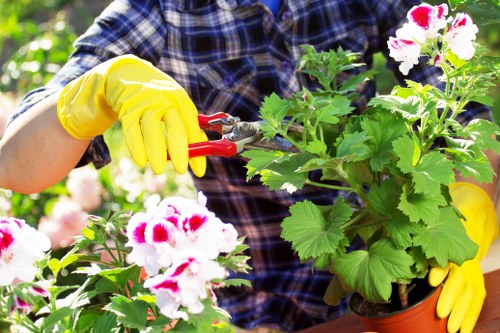 Gardeners Soho operates as a fully insured gardening company that places safety and liability protection at the heart of every project. Professionalism means more than neat hedges and healthy lawns; it means protecting clients, the public and our team through robust insurance, formal training and systematic risk control. In this overview we explain our approach to public liability insurance, staff training, personal protective equipment and our risk assessment process, using clear examples of how a reputable insured gardening firm protects everyone on site.
Public Liability Insurance: Why It Matters
Public liability insurance is the baseline safeguard for any reputable gardening company. Our policies are structured to cover accidental damage to third-party property, injury to members of the public and legal costs that may arise from claims following a gardening activity. As an insured gardening company, we carry comprehensive coverage that helps clients feel confident that unforeseen incidents will be managed professionally and responsibly.
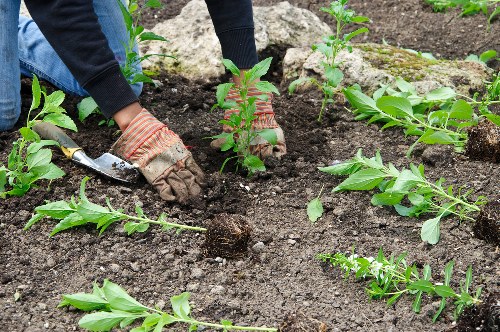 The scope of coverage typically includes accidental physical damage (for example, tools causing breakages), bodily injury (slips, trips or minor collisions), and third-party claims arising from our contracted work. We ensure our insurance limits are appropriate for both domestic and commercial sites, and we review policies regularly to match evolving operations. When you work with insured garden contractors, you are choosing a partner who can respond quickly and fairly to incidents without exposing clients to financial risk.
Staff Training: Competence and Continuous Development
All employees at Gardeners Soho complete structured induction and ongoing professional training. Training covers safe equipment operation, pesticide handling where applicable, manual handling techniques, and customer-site etiquette. Our commitment to training positions us as a leading insured gardening service, because an insured business is safest when its people are competent and risk-aware.
 Training is delivered through a mix of classroom sessions, on-the-job supervision and practical assessments. We maintain records of every operative's competency and certifications, and we schedule refresher courses so skills remain current. For high-risk tasks — such as chainsaw use, ladder work or tree surgery — only operatives with documented qualifications and experience are assigned. This structured program reduces the likelihood of incidents that could trigger a liability claim.
Key elements of our training program
Training at Gardeners Soho includes:
- Site-specific induction covering hazards and emergency procedures
- Equipment and tool training with competency sign-off
- Safe use of chemicals including COSHH awareness where relevant
- First aid and incident reporting to ensure rapid response
Personal Protective Equipment (PPE)
PPE is a simple but crucial control measure. Gardeners Soho enforces a clear PPE policy that is regularly audited and updated. Mandatory items include sturdy boots, cut-resistant gloves where appropriate, eye protection, hearing protection for noisy equipment and high-visibility clothing for roadside or busy-access sites. PPE is provided to staff and replaced on a planned schedule to ensure effectiveness.
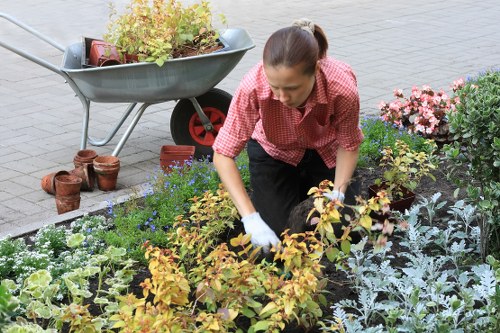 We adopt a proactive approach: operatives are briefed on correct PPE selection and care, and supervisors perform spot checks to ensure compliance. PPE is not a substitute for safe working methods, but it is an essential final barrier that reduces the severity of injuries when incidents occur. Where specialist tasks require respirators, harnesses or additional protective garments, those items are supplied and only used by trained staff.
 Maintaining an insured status means pairing insurance cover with demonstrable safety controls. Our PPE policy forms part of a broader safety management system that includes equipment maintenance, safe systems of work and clear communication channels for reporting hazards or near-misses. Together, these measures reduce the frequency and impact of claims and help maintain lower insurance premiums over time.
Risk Assessment Process: Systematic and Transparent
Risk assessment at Gardeners Soho follows a consistent, documented process adopted across every site. Before work begins we identify potential hazards, assess their likelihood and potential consequences, then implement proportionate controls. Assessments are recorded and shared with clients when appropriate, ensuring everyone understands the hazards and the steps taken to control them.
Our process typically includes: a site walkthrough to note hazards (slippery surfaces, confined spaces, overhead power lines), an evaluation of people at risk (public, staff, subcontractors), the implementation of control measures (signage, cordons, PPE), and a residual risk rating to determine whether additional safeguards are needed. Each assessment is logged, retained and revisited if conditions change.
To ensure continuous improvement we conduct periodic audits, review incident reports and adjust our procedures based on real-world learning. This closed-loop approach aligns with the expectations of insurers and helps demonstrate that safety and risk mitigation are integral parts of our business operations.
Why Choose a Fully Insured Gardening Contractor?
Working with a fully insured gardening contractor protects property owners and the public. Insurance provides financial backstop; training and PPE prevent incidents; and a robust risk assessment process reduces the chance of claims. At Gardeners Soho, we combine all three to deliver safe, dependable services.
Our records and practices are designed to be transparent and auditable: insurance certificates, training logs, PPE inventories and risk assessments are all managed so that clients can be confident they are hiring a fully insured gardening company that acts responsibly on every job.
Responsible gardening is about more than tidy borders: it is a commitment to safety, compliance and professional accountability. Gardeners Soho meets that commitment through comprehensive insurance cover, rigorous staff development, mandatory PPE standards and a structured risk assessment process that protects everyone involved.

